Everything in nature is connected.
A Taste of History
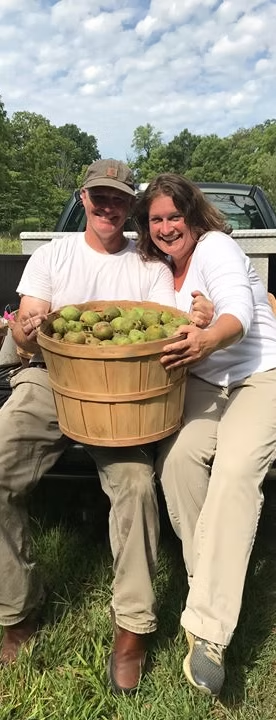
A small farm with a long memory.
Stillwater Valley Orchard and Apiary's philosophy is that we understand everything is connected in nature. Every organism has its role, place, and value in our beautiful world. This understanding guides our management of our orchard and honeybee apiary.
We use organic methods when it comes to growing our apples, our other produce, and in the management of our honeybees. We understand all too well the plight of the honeybee and the chemical overload of our modern society — and we like to play our part in lessening that load.
Stillwater Valley Orchard and Apiary is dedicated to providing nourishing produce for the body's health and well-being. We understand the health of the soil is the foundation of nourishing food.
We build our soils by using compost, wood mulches, and the planting of clover. This feeds the trees, which in turn give us nutrition. We keep mowing of the orchard to a minimum, because the tall grasses and weeds provide cover and food for all life.
We grow for our neighbors first.
Stillwater Valley Orchard and Apiary believes strongly in providing the local community with nourishing produce of historical variety, grown with organic methods, and honoring all life.
The small business and family farm play a pivotal role in bringing variety and nourishment to local communities. Small farms provide food security, because the food grown does not require long transportation routes. They also play a role in sustainability — our practices enrich the land and its life, not diminish it.
The local small farm cannot exist without the support of local people. We are all connected, and we need one another to enrich the community.
"I want to dig in the earth."
Stillwater Valley Orchard and Apiary is located in Englewood, Ohio, adjacent to the Englewood Reserve in the Stillwater River Valley. It was created with a vision in mind. I like to believe it started with a conversation at the dinner table when I was ten. A parent asked me what I wanted to do when I grew up. My reply was, "I want to dig in the earth." I remember a great laughter. Since then, I have dug a lot in the earth — planting well over 300 fruit trees.
Before Stillwater Valley Orchard and Apiary was created, the land was overgrown with trees and brush. Having never used a chainsaw or felled a tree, I cleared the land enough to plant a small orchard and establish a honeybee apiary. It was a great learning experience.
Twenty years a history teacher. A lifetime in the dirt.
I have always loved and appreciated history. I spent 20 years teaching it as a public school teacher. My love of history and love of planting meshed into the vision I wanted for this project.
By creating Stillwater Valley Orchard and Apiary, I wanted to provide an opportunity for the public to enjoy a unique experience by sampling very old varieties of apples from Europe, Asia, and Colonial America. These old varieties were enjoyed and cherished by peoples across the centuries — many created in backyards from a saved seed, carrying an individual's name or a geographical point rather than a label from a research lab.
Unfortunately, these apples were discarded by the modern agricultural system for a variety of reasons. Fortunately, enough people kept these old apple and garlic varieties alive by growing them.
I want to bring these apple varieties back to our food culture. They have a taste and appearance unlike anything you will find in the chain grocery stores. Stillwater Valley Orchard and Apiary is an apple tree sanctuary meant to keep the past alive — so that you may have a taste of history.
We have recently partnered with the Johnny Appleseed Educational Center and Museum in Urbana, Ohio to grow and propagate an authentic apple tree variety planted by John Chapman — Johnny Appleseed — found on a farm in Savannah, Ohio. We will offer scions and grafted apple trees to the public from 1994 cuttings of this tree, propagated here at Stillwater Valley.